

October 26-30
The program of the 2026 edition of the Global Social Progress Week is below.
The links to access the sessions are included in the program.
| OPENING SESSION MONDAY, OCTOBER 26 08:00 US EDT/ 12:00 UTC | Co-chairs: Elisa Reis Ravi Kanbur | Panel: Margo Thomas Hossain Zillur Rahman |
| SESSION 1 Bolstering the community of inquiry: What AI in education means for sociality, equality, and citizenship MONDAY, OCTOBER 26 9:30 US EDT/ 13:30 UTC | Chair: Elisa Reis | Panel: Lisa Herzog Eloise Soulier Jason Branford Shafika Isaacs Imogen Casebourne Pak-Hang Wong |
Session presentation:
The policy paper “Bolstering the community of inquiry” discusses an underexamined perspective concerning the potentials and risks of AI use in education: the relation of education and democracy, and the fact that education shapes not only future employees, but also future citizens. We base these reflections on a Deweyan conception of democracy as encompassing not only formal institutions, but also the informal culture and social relations of democratic citizenship. From this perspective, the interrelation between democracy and education forms an important point of attention. The impact of AI on this interrelation has not, until now, received sufficient attention. We argue that the considered use of AI in education must attend to at least three democratic dimensions: (1) education and sociality – does AI use reinforce or undermine the social nature of learning and knowledge production, as well as the acquisition of essential social skills? (2) education and equality – can AI help disadvantaged children to catch up, or does it reinforce the gaps between those from different backgrounds? Can it foster meaningful egalitarian relations in the classroom and beyond? (3) education and citizenship – can AI help with, or does it hinder, the development of democratic attitudes and values, and the acquisition of democratic skills such as independent reasoning, deliberation and collaboration among equals? We call upon educators and policy-makers to consider the shifts in power and authority that the endorsement of AI can bring, and for a nuanced approach that brings the use of this technology in educational settings in line with democratic values and social progress. We argue for the need to create community, embrace the essential role of friction, and keep challenging the added value of AI in educational contexts.
In the webinar, the authors of the policy paper present the main arguments of this policy paper, followed by commentaries from two experts: Pak-Hang Wong, a philosopher and ethicist of technology based in the Academy of Chinese, History, Religion and Philosophy and a Research Fellow at the Centre for Applied Ethics at Hong Kong Baptist University, and Shafika Isaacs, Chief of Section for Technology and AI in Education at UNESCO headquarters in Paris and Professor of Practice at the University of Johannesburg.
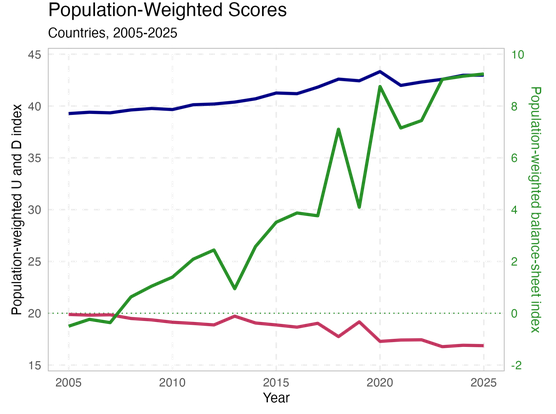
| SESSION 2 Progress with red flags: The Utopia-Dystopia balance sheet of social progress MONDAY, OCTOBER 26 13:00 US EDT/ 17:00 UTC | Co-chairs and panelists: Gala Diaz-Langou Marc Fleurbaey Nora Lustig |
Session presentation:
This sesssion presents a preview of the new indicators of social progress produced by IPSP. More than 190 countries, over the 2005-2025 period, are covered by this analysis. The indicators take the form of a “Utopia-Dystopia Balance Sheet” with a positive side and a negative side, each representing fractions of the population living under good or bad conditions. The balance sheet includes the following domains:
- Material well-being (income, wealth, labor inclusion, social protection)
- Education (literacy, learning, education level, inclusion)
- Health (longevity, child mortality, chronic disease, financial protection)
- Quality of institutions (political participation, political rights, corruption, institutional confidence, satisfaction with public services)
- Environmental quality (air pollution, disasters, water quality)
- Social cohesion (gender representation, social connectedness)
- Security (organized violence, detention, subjective safety, forced displacement)
- Subjective well-being (life evaluation, daily experiences)
In addition to the balance sheet, a set of “red flags” pinpoint serious institutional failures at the country level.
The co-chairs of the task force which has produced these new statistics will present the results and discuss them with the audience.
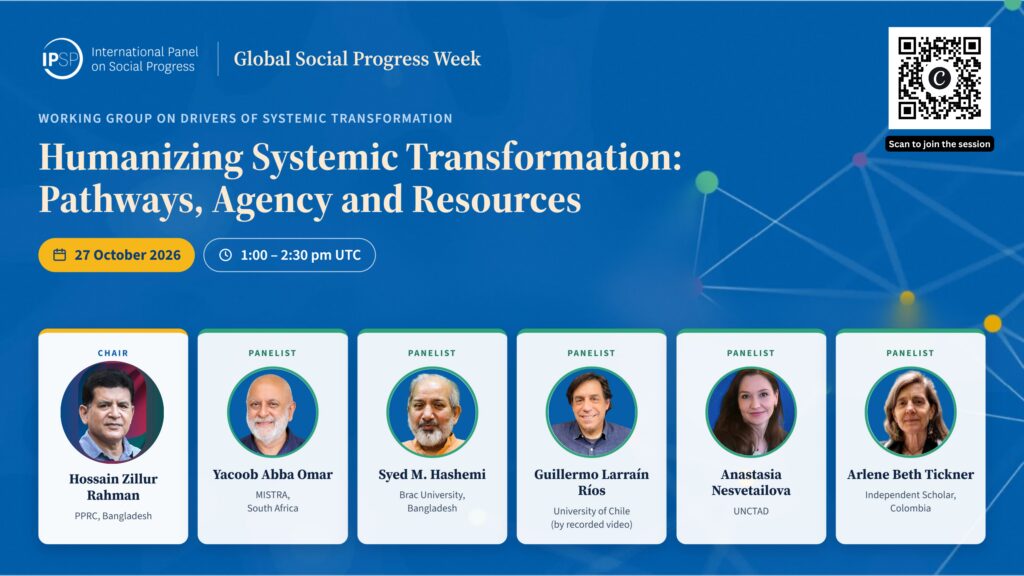
| SESSION 3 Humanizing systemic transformation: Pathways, agency and resources TUESDAY, OCTOBER 27 09:00 US EDT/ 13:00 UTC | Chair: Hossain Zillur Rahman | Panel: Yacoob Abba Omar Guillermo Larrain Ríos Anastasia Nesvetailova Syed M Hashemi Arlene Beth Tickner |
Session presentation:
The session seeks to contribute to the evolving social progress agenda through an enquiry into why promises of systemic transformation often fail and which entry points carry strategic promise in a global landscape of crises, uncertainty and flux. The discussion will examine the relevance of statist solutions, the rise of intangible capital, new development pathways, and the disconnect between institutional structures and grassroots agency. The discussion will be situated within a longer view where erstwhile political visions for systemic transformation have to contend with the waning relevance of classical models of development centred on industrialization, productivity growth, and trade integration and growing interconnectedness of political, economic and financial dominance as exemplified by the rise of tech giants as well as the global erosion of the middle class, and growing precarity and political radicalism tied to unmet development expectations.
Due to growing disillusionment with elite-driven national-level efforts, a new focus is on grassroots transformation rooted in the agency and lived realities of the grassroots. However, grassroots agency alone is not enough. Systemic transformation demands engaging with entrenched power structures and institutional inertia and the need to activate agency at micro, meso and macro levels. The session will explore the enablers and barriers to such transformation, including social protection, public trust, and financial and institutional coordination as levers for transformation. It will draw on experiences that highlight systemic issues, with due attention to studying failures and lost chances alongside success cases. To be truly relevant to the social progress agenda, such analysis must be capable of articulating visions of the future that resonate with people and respond to real anxieties, offering meaningful, forward-looking alternatives. The challenge thus is at once analytical and moral, with love, unlike revenge or anger, imagined as the central organizing principle in justice-based transformation.
- Chair: Hossain Zillur Rahman, PPRC, Bangladesh
- Panel:
- Yacoob Abba Omar, MISTRA, South Africa
- Syed M. Hashemi, Brac University, Bangladesh
- Guillermo Larrain Ríos, University of Chile (by recorded video)
- Anastasia Nesvetailova, UNCTAD
- Arlene Beth Ticker, Independent Scholar, Colombia
| SESSION 4 Measuring poverty under the poor’s guidance: A participatory approach TUESDAY, OCTOBER 27 10:30 US EDT/ 14:30 UTC | Chair: Marc Fleurbaey | Panel: Thomas Lellouch Beatriz Monje Barón Benoît Reboul-Salze Eléonore Richard |
Session presentation:
This session will present a participatory project in which the French institute of statistics (INSEE) collaborated with two charities (ATD Fourth World and Secours Catholique Caritas France) to elicit the expertise of people living in poverty and improve the statistical surveys and the measurement of poverty. The project has produced concrete changes to survey questionnaires and has transformed the participants, empowering the participants who shared their experience of poverty, and showcasing the value of participatory statistics.
The session will start with a screening of the trailer of the documentary that describes the project through interviews of its participants. The session will then contain a conversation with coordinators of the project, from INSEE and ATD Fourth World, discussing how the work was organized and why it mattered to the individual participants and the partnering organizations. The goal of this session is to foster a greater use of participatory methods in the design of surveys and the measures of social facts. There is an INSEE working paper (in French) describing the project and its results. The discussion will also bear on the Inclusive and Deliberative Elaboration & Evaluation of Policies (IDEEP) tool developed by ATD Fourth World.
- Thomas Lellouch (INSEE), responsible for severe poverty statistics.
- Beatriz Monje Barón (ATD Fourth World), coordinator of the IDEEP program.
- Benoît Reboul-Salze (ATD Fourth World), national delegate.
- Eleonore Richard (PSE and DREES), researcher.
| SESSION 5 The paradox of unhappy growth: Is the US an outlier? TUESDAY, OCTOBER 27 12:00 US EDT/ 16:00 UTC | Chair: Margo Thomas | Panel: Carol Graham Caspar Kaiser Andrew Clark |
Session presentation:
A recently published paper by Carol Graham and colleagues, builds on her previous work on the Economics of Happiness and interrogates the paradox of the United States’ relatively consistent high economic growth while there are alarming trends in the decline of economic wellbeing (mainly for those that are poor or middle class) and many other wellbeing dimensions, including hope, freedom to choose how to live your life, and trust in government and institutions running parallel with increasing declines in mental health and premature mortality, with the latter one rising most rapidly among youth.
Professor Graham will present the key questions and findings of the paper, including the analyses of the United States performance in relation to other high- and middle-income economies.
The panel will build on this discussion and present their views on the underlying drivers of this paradox, implications for social progress with the United States and the social progress agenda more broadly.
| SESSION 6 Living wages: Benefits and impacts; companies and supply chains; informality THURSDAY, OCTOBER 29 08:00 US EDT/ 12:00 UTC | Chair: Romina Boarini | Panel: Ravi Kanbur Carlotta Balestra Matteo Squire Zoe Long Martha Chen Filip Stefanovic |
Session presentation:
This session will present the production of the Working Group on the Living Wage, by members of the working group. Three policy briefs have now been finalized and are being considered for peer review and publication in a new journal, the International Journal of Social Progress. The policy briefs are:
- Benefits and Impacts of Living Wages (prepared by Carlotta Balestra, Suzana Hardy and Alessandro Facchini)
- Barriers and Enablers from a Private Sector Perspective (prepared by Matteo Squire)
- Informality and the Living Wage (prepared by Martha Chen and Ravi Kanbur)
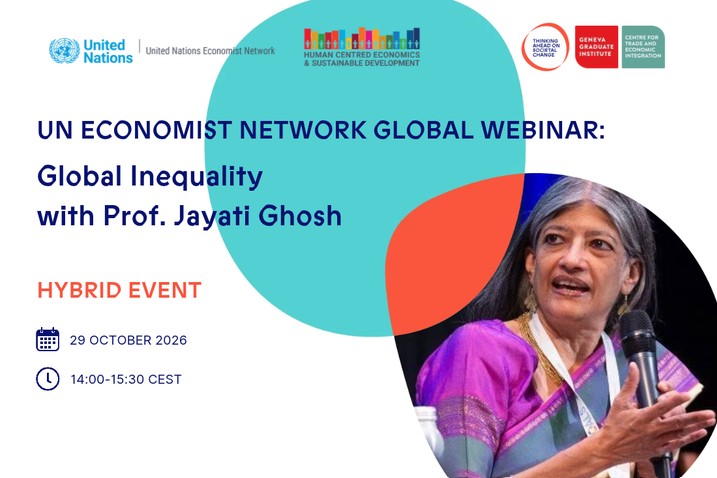
| SESSION 7 (In partnership with UNEN) G20 Report on inequality THURSDAY, OCTOBER 29 09:00 US EDT/ 13:00 UTC | Chair: Rick Samans | Panel: Jayati Ghosh (speaker) Marc Fleurbaey (discussant) Marta Roig (discussant) |
Session presentation: THIS SESSION REQUIRES REGISTRATION
This session is part of the series of UN Economist Network global webinars in association with several leading international academic networks. The featured speaker in this session will be University of Massachusetts Amherst Professor of Economics Jayati Ghosh on the topic of global inequality, including the report of the G20 Extraordinary Committee of Independent Experts on Inequality of which she was a member. That report has inspired efforts to form an International Panel on Inequality (IPI) modelled in part on the IPCC.
The two discussants will be Paris School of Economics Professor and IPSP Founding Member Marc Fleurbaey and Marta Roig, Chief of Emerging Issues and Trends Section, UN DESA and co-lead of the World Social Report 2025. Prof. Ghosh’s opening remarks and the comments by the two discussants will be followed by an interactive discussion with the global webinar audience of UN and academic economists. This session is organized in association with the International Panel on Social Progress and its Global Social Progress Week.
Registration is required for this session.
| SESSION 8 New narratives for the Common Good FRIDAY, OCTOBER 30 08:00 US EDT/ 12:00 UTC | Chair: Colin Bradford | Panel: Sergio Bitar Olav Kjorven Erkki Tuomioja Henry Wang Richard Samans |
Session presentation:
This session takes as a premise that the main challenge for Politics is not WHO becomes the leader but WHAT are the New Narratives. Speakers will introduce Five Big Drivers of Systemic Change :
- Sergio Bitar: Visioning the Future as vital for guiding systemically sustainable policies for society-as-a-whole, translating long-term strategic thinking into pragmatic policy making.
- Olav Kjorven: A Community cannot exist without rules, norms & standards. Humanity faces an existential risk of failing to become a community, unless principles are respected.
- Erkki Tuomioja: Power of Narratives to Vision the Future and Create Community. Systemic risks being a galvanizing force for “visioning the future” to achieve systemic sustainability and holding humanity together as a single international community.
- Henry Wang: Syncretism (Blending contrary narratives) vs Binaries, to clarify the destructive power of framing public choices as binaries: us versus them; competition versus cooperation; state versus market; and authoritarianism versus democracy.
- Richard Samans: Economics as Moral Philosophy. The failure of economics to sufficiently prioritize social inclusion and deliver for society as a whole, due in part having been captured by neoliberalism in the late 20th century, departing from its roots in philosophy in the 19th century.
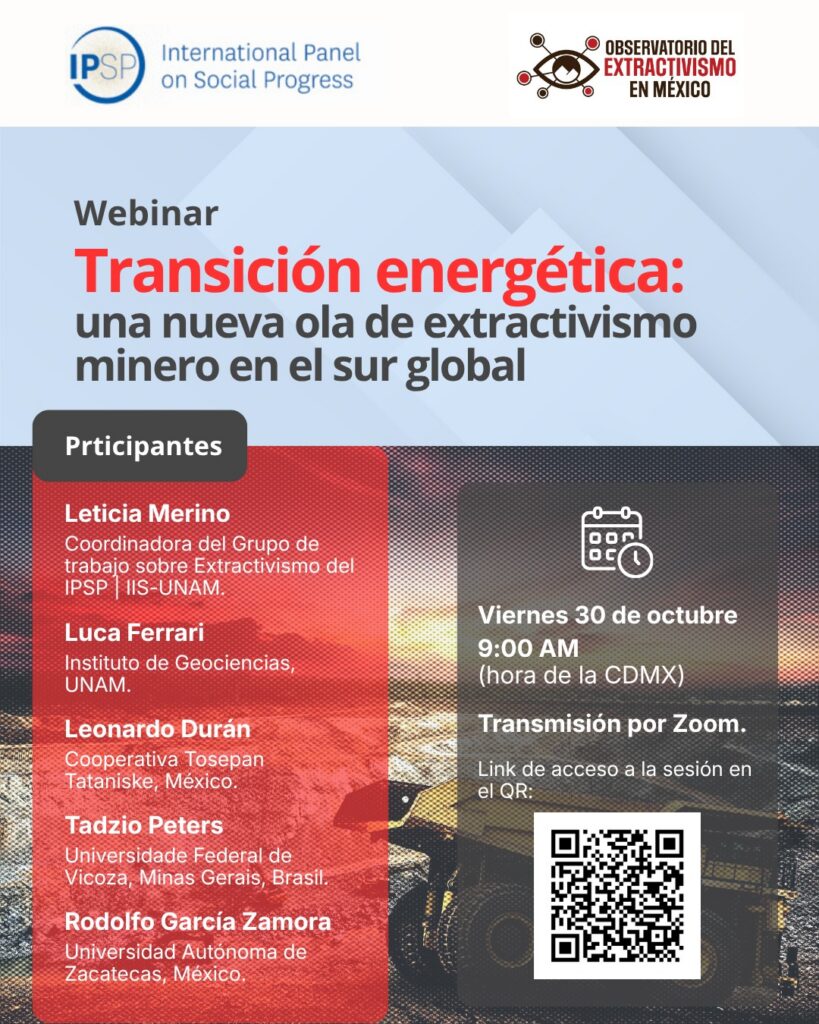
| SESSION 9 Energy transition: A new wave of Global South extractivism FRIDAY, OCTOBER 30 11:00 US EDT/ 15:00 UTC | Chair: Leticia Merino | Panel: Luca Ferrari Leonardo Durán Tadzio Peters Rudolfo Garcia |
Session presentation:
During the next decades, the demand for “critical minerals” will constantly multiply, led by the fabrication of (individual) electric vehicles, lithium batteries, solar panels, electronic devices, and armaments. The demand of lithium, cobalt, copper, graphite, nickel, silver and rare earths faces already important shortages. Many of the deposits of these minerals are becoming depleted, and more aggressive, water intensive techniques of extraction, need to be applied. Meanwhile, more than 50% of the deposits are located in regions with high water stress, and many in areas of ecological fragility.
As the control of the access and processing of critical minerals is defined by the United States, China and the members of the European Union, as an issue of national security, increasing geopolitical tensions are arising. On the other hand, the dispute and demand for critical minerals is giving way to a new wave of extractivism that reinforces the traditional North–South divide. Old patterns of control of the production chains dominate in the US and now in China, while in Latin America, Africa and Southeast Asia mining regions, small locally produced value added, over-exploitation and contamination of water resources, deforestation, loss of biodiversity and of nature based livelihoods, together with confrontation, violence, and chronic diseases become prevalent.
In this context the panel aims to discuss the elements of progressive policy agendas in countries of Latin America, that protect human and indigenous rights, and nature and make visible the high costs of the energy transition based on increasing consumption and constant economic growth.
Participants:
- Leticia Merino, Coordinator of the IPSP Working Group on Extractivism, Institute of Social Research, Universidad Nacional Autónoma de México (UNAM)
- Luca Ferrari, Institute of Geophysics (UNAM)
- Leonardo Durán, Cooperative Tozepan Tatanizke, México
- Tadzio Peters, Universidade Federal de Vicoza, Minas Gerais, Brazil
- Rodolfo García Universidad Autónoma de Zacatecas, México
| CLOSING SESSION From insight to action – Challenges & opportunities: The role of IPSP FRIDAY, OCTOBER 30 12:30 US EDT/ 16:30 UTC | Chair: Hossain Zillur Rahman | Panel: Olivier Bouin Gerald Chirinda Gala Diaz Langou Gabriela Ramos Margo Thomas |